By Aaron Rennie
12:47 PM EST
:max_bytes(150000):strip_icc():format(webp)/GettyImages-2257228220-7f277682ea2b4558bc2c210f21d6e881.jpg "Dow Jones Today: Stock Indexes Mixed to End Volatile Week; Intel Shares Dive on Soft Outlook; Gold Nears $5,000; Silver Hits $100")
14 Low-Stress Jobs to ConsiderClose
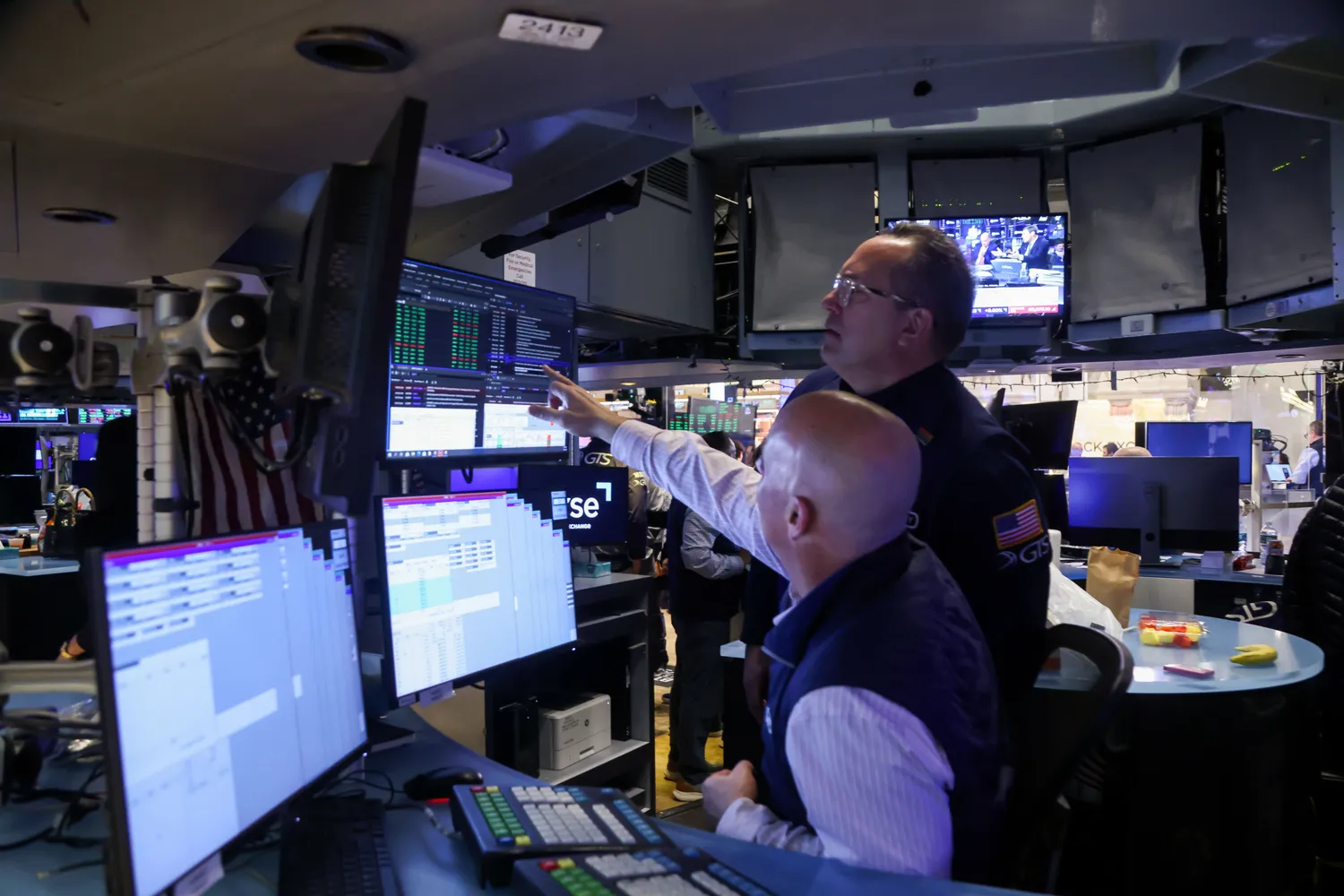
Major stock indexes were mixed on the final day of a volatile week of trading, while safe-haven gold and silver futures set fresh all-time highs.
The Dow Jones Industrial Average declined 0.5% in recent trading, while the Nasdaq and S&P 500 were up 0.4% and 0.1%, respectively. Yesterday, the major indexes closed sharply higher for a second straight session after President Donald Trump reduced tensions with European allies by backing off his threat of imposing new tariffs over Greenland.
Despite the two-day rally, the blue-chip Dow and benchmark S&P 500 are on pace to close lower for the holiday-shortened week, as indexes suffered their worst session since Oct. 10 on Tuesday. The tech-heavy Nasdaq was poised to end slightly higher over the four trading days, with stocks and bond markets having been closed Monday for Martin Luther King Jr. Day. All three indexes closed lower last week, and the S&P 500 has not posted two consecutive weeks of losses since June.
Amid the volatility, investors have poured money into safe-haven gold futures, which set their latest all-time high Friday, reaching nearly $4,990 an ounce. Silver futures also hit a record high, topping $100 an ounce for the first time.
The yield on the 10-year Treasury—which impacts interest rates on a variety of consumer loans including mortgages—was little changed from Thursday’s close around 4.25%.
Bitcoin was trading at roughly $90,700, up from the day’s low of below $88,500. The U.S. dollar index, which tracks the value of the greenback against a basket of global currencies, was 0.7% lower at 97.72. West Texas Intermediate crude futures, the U.S. benchmark, was up 2.7% to $60.97 a barrel.
Shares of Intel (INTC) sank 16% to pace S&P 500 and Nasdaq decliners after the chipmaker issued a soft outlook and executives warned that supplies could hit a low in the current quarter.
Shares of Oracle (ORCL) rose less than 1% following news its cloud services will host TikTok’s American user data after the social media company formed a joint venture to comply with an executive order signed by President Trump in September to keep it operating in the U.S.
Capital One Financial (COF) stock was down almost 7% after it acquired credit card startup Brex for more than $5 billion.
Ericsson (ERIC) shares surged 9% after the Swedish maker of telecommunications equipment reported better-than-expected fourth-quarter profit, lifted its dividend, and announced a roughly $1.7 billion buyback.
January 23, 2026 12:47 PM EST
TikTok Finally Has a Trump-Brokered US Deal. Who Are Its New American Investors?
FROM 25 minutes ago
TikTok has finally ironed out a deal giving American investors a majority stake in its U.S. business. One of them is a big name in tech.
The social media platform on Thursday said it has finished the details of an agreement bringing the previously Chinese-owned app’s U.S. operations under a joint venture controlled by a group of American investors. Larry Ellison’s Oracle (ORCL) is one of the largest investors, along with private equity firm Silver Lake and Abu Dhabi-based MGX, each holding 15%. ByteDance is retaining a 19.9% stake.
Other investors include the family office of Dell (DELL) founder Michael Dell and Revolution, Vice President J.D. Vance’s former employer.
:max_bytes(150000):strip_icc():format(webp)/GettyImages-2256624678-212178d16861447cbc9b17adb6490dad.jpg "Dow Jones Today: Stock Indexes Mixed to End Volatile Week; Intel Shares Dive on Soft Outlook; Gold Nears $5,000; Silver Hits $100")
Read the full article here.
January 23, 2026 11:21 AM EST
How Your Student Loan Balance Compares to the Average 35-to-49-Year-Old
FROM 1 hr 51 min ago
Are you a federal student loan borrower between the ages of 35 and 49? Here’s how your balance and repayment status compare with other borrowers your age.
About 14.9 million borrowers ages 35 to 49 hold $674.9 billion in student loan debt as of September 2025, according to the Department of Education’s most recent data. This age group holds the most debt and includes the most borrowers, with borrowers ages 35 to 49 accounting for about 34% of total student loan borrowers.
:max_bytes(150000):strip_icc():format(webp)/GettyImages-2183316979-f852f9e0c2b24bf185c3c4dabff7a1e2.jpg "Dow Jones Today: Stock Indexes Mixed to End Volatile Week; Intel Shares Dive on Soft Outlook; Gold Nears $5,000; Silver Hits $100")
The average borrower in this group owes about $45,295, the second-highest average of all age groups.
Read the full article here.
January 23, 2026 10:50 AM EST
Capital One Leads S&P 500 Industrials Sector Lower
FROM 2 hr 23 min ago
Financial shares are underperforming in early trading. Capital One shares are partly to blame.
The S&P 500 Financials Sector was the worst performer of the 11 industries tracked by the benchmark index Friday morning, down roughly 1.2%.
Capital One Financial (COF) shares were more than 5% lower, the worst individual sector component.
Goldman Sachs Group (GS), Erie Indemnity (ERIE), and Corpay (CPAY) also were having poor starts to the session, down between 2% and 3% apiece.
:max_bytes(150000):strip_icc():format(webp)/GettyImages-2209791817-937796607fc549b18d217c24a201f05d.jpg "Dow Jones Today: Stock Indexes Mixed to End Volatile Week; Intel Shares Dive on Soft Outlook; Gold Nears $5,000; Silver Hits $100")
January 23, 2026 09:27 AM EST
Booz Allen Hamilton ‘Getting Its Groove Back’ After Lifted Profit Outlook
FROM 3 hr 46 min ago
Booz Allen Hamilton Holding (BAH) is “getting its groove back” after the advanced technology company and government contractor raised its fiscal 2026 profit forecast as it reported third-quarter results, according to William Blair analysts.
The McLean, Va.-based firm now sees full-year adjusted earnings per share of $5.95 to $6.15, up from its prior projection of $5.45 to $5.65.
“There was risk to the full-year outlook heading into this quarter as the impact of the government shutdown was unknown, and investors were looking for any sign of strength,” the analysts wrote.
In Q3, Booz Allen posted adjusted EPS of $1.77, well above expectations of $1.28. Revenue of $2.62 billion came up short of the consensus estimate of $2.72 billion.
Booz Allen shares were up 10% before the bell. They entered Friday down about 30% over the past year.
:max_bytes(150000):strip_icc():format(webp)/BAH_2026-01-23_09-26-21-64daa76eb43243cf8d53abe6610fbb90.png "Dow Jones Today: Stock Indexes Mixed to End Volatile Week; Intel Shares Dive on Soft Outlook; Gold Nears $5,000; Silver Hits $100")
January 23, 2026 09:01 AM EST
Sallie Mae Stock Surges on Profit Beat, $500M Buyback
FROM 4 hr 12 min ago
Shares of SLM Corp. (SLM) popped 8.5% before the bell Friday, a day after the company better known as Sallie Mae reported better-than-expected fourth-quarter profit and announced a $500 buyback program.
The Newark, Del.-based student loan company reported Q4 profit of $1.12 per share. Analysts surveyed by Visible Alpha had expected $0.93 per share.
In addition, Sallie Mae said it was announcing a half-billion-dollar, 24-month share repurchase program, and that it had $33 million capacity remaining on its 2024 buyback program.
SLM Corp. shares entered the day down about 9% over the past year.
:max_bytes(150000):strip_icc():format(webp)/SLM_2026-01-23_09-00-36-6968923983774350b0a155b0e6171648.png "Dow Jones Today: Stock Indexes Mixed to End Volatile Week; Intel Shares Dive on Soft Outlook; Gold Nears $5,000; Silver Hits $100")
January 23, 2026 08:26 AM EST
US Airlines Cancel Nearly 2,000 Flights Because of Massive Storm
FROM 4 hr 47 min ago
American Airlines (AAL), Southwest Airlines (LUV), and their fellow carriers have canceled hundreds of flights ahead of a massive storm.
American Airlines canceled 64 flights scheduled for Friday and 529 for Saturday, while Southwest nixed 94 today and 235 tomorrow, according to flight tracker FlightAware.
The two carriers are based in the Dallas area, which has seen the most cancellations. Dallas-Fort Worth International airport, a hub for American, has 547 flights canceled for Saturday, while Dallas Love Field, where Southwest has a major presence, has 69 cancellations.
All told, U.S. airlines have canceled nearly 2,000 flights through Sunday.
Shares of American and Southwest were little changed and down about 0.5%, respectively, before the bell.
:max_bytes(150000):strip_icc():format(webp)/GettyImages-2255825108-9d55daa60c844054873c0b52d3e9d93c.jpg "Dow Jones Today: Stock Indexes Mixed to End Volatile Week; Intel Shares Dive on Soft Outlook; Gold Nears $5,000; Silver Hits $100")
January 23, 2026 07:35 AM EST
The Federal Reserve Is Still Dealing With the Shutdown’s ‘Data Fog’
FROM 5 hr 37 min ago
The 43-day government shutdown may feel like ancient history, but it’s still fouling up key economic data.
The government’s official reports on inflation have been both delayed and distorted by the shutdown that spanned October and part of November. That’s complicating the job of Federal Reserve officials who meet next week to set the nation’s monetary policy.
:max_bytes(150000):strip_icc():format(webp)/Fed-9a545b26d0a243ebba859a5a0cb8d499.jpg "Dow Jones Today: Stock Indexes Mixed to End Volatile Week; Intel Shares Dive on Soft Outlook; Gold Nears $5,000; Silver Hits $100")
Thursday’s report on Personal Consumption Expenditures inflation, which normally covers December, instead covered only October and November, as the Bureau of Economic Analysis played catch-up. Monthly PCE reports won’t get back to their regular schedule until April.
The other major inflation report, the Consumer Price Index, was also affected. The Bureau of Labor Statistics skipped gathering October data entirely, since the agency could not carry out the surveys it uses to make the report. The agency also collected prices later in November than it normally would, leading some economists to speculate that holiday sales may have distorted the data.
Read the full article here.
January 23, 2026 06:36 AM EST
After Trump’s Greenland Deal, Wall Street Is Talking Up the ‘TACO Trade’ Again. What’s Next?
FROM 6 hr 36 min ago
Yesterday was Taco Thursday on Wall Street.
U.S. stocks, which rallied Wednesday, extended their gains Thursday after President Donald Trump said he would not use force to take over Greenland nor impose new tariffs on a group of European nations after the U.S. and NATO reached a “framework of a future deal” on Greenland’s sovereignty.
The détente revived talk on Wall Street of the TACO, or “Trump Always Chickens Out,” concept, which broadly refers to the president’s habit of threatening steep tariffs or other dramatic actions before reducing, delaying, or canceling them. This has inspired the so-called TACO Trade, in which investors buy assets rattled by the president’s threats under the assumption they’ll eventually rebound.
:max_bytes(150000):strip_icc():format(webp)/GettyImages-2256963613-48618f4856bb4cf7ae0db71ebb4db977.jpg "Dow Jones Today: Stock Indexes Mixed to End Volatile Week; Intel Shares Dive on Soft Outlook; Gold Nears $5,000; Silver Hits $100")
“TACO” entered Wall Street’s lexicon via Financial Times columnist Robert Armstrong. “The US administration does not have a very high tolerance for market and economic pressure, and will be quick to back off when tariffs cause pain,” wrote Armstrong in May as stocks rebounded from the carnage of “Liberation Day.”
Later that month, Trump appeared to confirm Armstrong’s theory. Stocks soared on May 12 after the U.S. and China agreed to a 90-day pause on tariffs exceeding 100%, and jumped again weeks later when Trump announced a similar pause on tariffs targeting the EU.
Read the full article here.
January 23, 2026 06:01 AM EST
Stock Futures Slip to End Volatile Week of Trading
FROM 7 hr 11 min ago
Futures contracts connected to the Dow Jones Industrial Average pointed down 0.3%.
:max_bytes(150000):strip_icc():format(webp)/YM1_2026-01-23_05-55-10-593451a43c5c414aa1a7dd5df58f873c.png "Dow Jones Today: Stock Indexes Mixed to End Volatile Week; Intel Shares Dive on Soft Outlook; Gold Nears $5,000; Silver Hits $100")
S&P 500 futures also slipped 0.3%.
:max_bytes(150000):strip_icc():format(webp)/ES1_2026-01-23_05-55-21-046d7654c853449d94f5a8abfeba6af8.png "Dow Jones Today: Stock Indexes Mixed to End Volatile Week; Intel Shares Dive on Soft Outlook; Gold Nears $5,000; Silver Hits $100")
Nasdaq 100 futures were 0.4% lower.
:max_bytes(150000):strip_icc():format(webp)/NQ1_2026-01-23_05-55-30-3c42d38cc6e949c3a46da9f4a2eb72d5.png "Dow Jones Today: Stock Indexes Mixed to End Volatile Week; Intel Shares Dive on Soft Outlook; Gold Nears $5,000; Silver Hits $100")